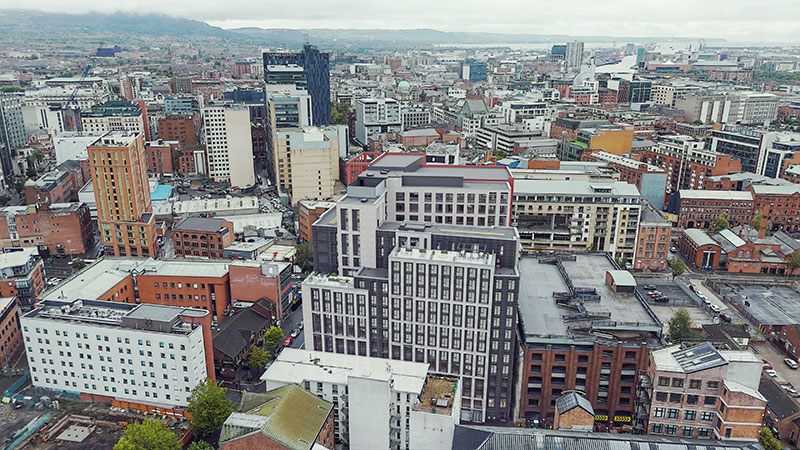
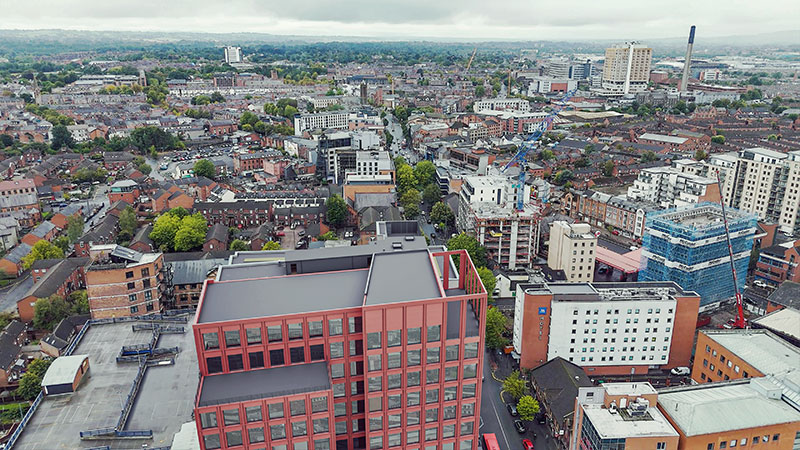
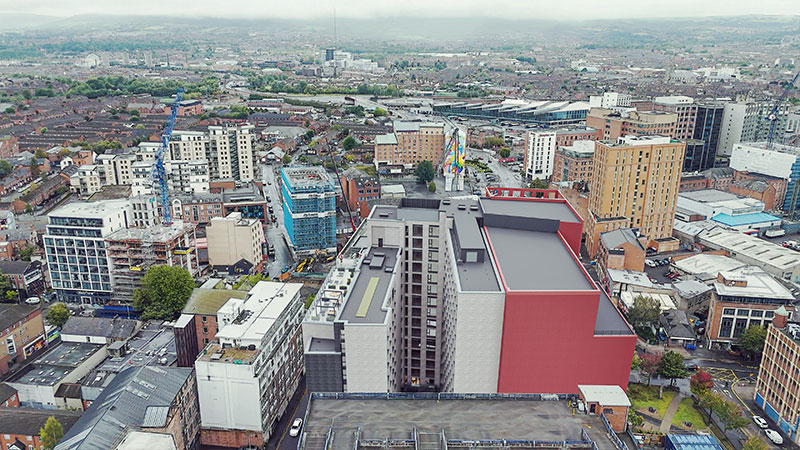
Queen’s University of Belfast’s new student accommodation featuring 459 beds, communal facilities, and internal and external communal spaces will open in 2026 on the Dublin Road, Belfast.
Botanic Avenue is a lively thoroughfare in south Belfast, located in the city’s “Queen’s Quarter” area near Queen’s University Belfast. It sits within walking distance of the city centre and other key landmarks: the avenue is a bustling retail thoroughfare in South Belfast within easy walking distance to Queens University and Belfast City Centre.


One Elmwood brings Student Services and the Students’ Union together under one roof—creating a space where support, study, and social life seamlessly blend from your first question to your final year.
Access expert guidance on wellbeing, accessibility, academic skills, careers, and finance. Get SU advice on housing, money, and academics, and explore clubs, volunteering, enterprise, or student representation.
Catch up with friends, study in tech-friendly spaces, grab lunch from the SU Shop, enjoy a pint in the Union Bar, or take in a live gig at Mandela Hall—all in one vibrant, student-focused space.


The Lanyon Building is the iconic centerpiece of Queen’s University Belfast, Northern Ireland. Designed by the renowned English architect Sir Charles Lanyon, it was completed in 1849 and remains one of Belfast’s most celebrated examples of Victorian Gothic Revival architecture.
Constructed from warm red brick and sandstone, the building’s striking façade, central tower, and ornate detailing reflect the grandeur and confidence of mid-19th-century design. The layout was inspired by the Tudor-style quadrangles of Oxford and Cambridge, symbolizing academic tradition and prestige.
Originally housing lecture rooms, laboratories, and administrative offices, the Lanyon Building continues to serve as the heart of the university today. It stands not only as an architectural landmark but also as a symbol of Belfast’s educational and cultural heritage. The surrounding grounds, including the Quadrangle and Main Site, provide a picturesque setting that attracts students, visitors, and photographers alike.
Photograph (top) by Dr Anna Hanuszkiewicz, Centre for Infection and Immunity
The Great Hall. Photograph (bottom) by Dr Anna Hanuszkiewicz, Centre for Infection and Immunity


The McClay Library, located at the top of Botanic Avenue in Belfast, is part of Queen’s University Belfast (QUB) and serves as the university’s main library. Opened in July 2009, it was one of the most significant construction projects undertaken by QUB since the historic Lanyon Building. The library is named in honour of Sir Allen McClay, a distinguished Northern Irish entrepreneur and philanthropist whose generosity made the project possible.
Architecturally, the McClay Library is a blend of modern design and functionality. It was designed by the American firm Shepley, Bulfinch, Richardson & Abbott in collaboration with the Belfast-based Robinson Patterson Partnership. The building features a striking multi-storey atrium filled with natural light thanks to its extensive glass façade. Sustainability was a major focus in its design, and in 2010 it won the Royal Institution of Chartered Surveyors (RICS) Sustainability Award for being one of the most environmentally conscious buildings in Northern Ireland.


Located just north of Belfast’s city centre, the Botanic Gardens is one of the city’s most cherished green spaces — a haven of tranquillity and natural beauty. Established in 1828, the gardens were originally created as a private park for scientific study and recreation, but were opened to the public in 1895. Today, they remain a popular spot for relaxation, walking, and cultural events.
At the heart of the gardens stands the iconic Palm House, one of the earliest examples of a curvilinear cast-iron glasshouse in the world. Designed by Sir Charles Lanyon and completed in 1840, the Palm House is an architectural masterpiece that showcases the Victorian fascination with exotic plants. Inside, visitors can explore a lush collection of tropical species, vibrant flowers, and towering palms that thrive in its warm, humid climate.
The gardens also feature the Tropical Ravine House, home to a rich array of ferns, orchids, and other tropical plants, as well as beautifully landscaped lawns and walking paths. Together, the Botanic Gardens and Palm House offer a living museum of plant life — blending horticultural heritage, scientific curiosity, and natural serenity in the heart of Belfast.


The Ulster Museum is one of Northern Ireland’s leading cultural institutions, located in the Botanic Gardens in south Belfast. It is part of National Museums NI and offers visitors a rich journey through art, history, and science. The museum’s collections cover a wide range of topics, including archaeology, natural history, ethnography, and fine and applied art.
Founded in 1929 and significantly expanded in 1962, the museum underwent a major refurbishment in 2009, which modernized its galleries and facilities while preserving its iconic Brutalist architecture. Today, it attracts hundreds of thousands of visitors each year, making it one of Northern Ireland’s most popular attractions.

Elms BT9 is a student village, offering a range of modern, comfortable and secure accommodation just 15 mins walk or a short bus ride from Queen’s campus.
Set in a residential location, there are 50 three-storied accommodation blocks with 10-11 bedrooms with a shared common room and kitchen on each floor.
The village includes the Treehouse, which is the main social space for all students living with us and includes the coffee bar, snooker & pool tables, table tennis, TV lounge with 2 x 85 inch TV screens with BT Sports, games & karaoke room, 2 bookable kitchen spaces, outdoor BBQ area, computers and high-speed internet.


The Medical Biology Centre (MBC) at Queen’s University Belfast is one of the university’s most important facilities for teaching and research in medicine and the biomedical sciences. Located at 97 Lisburn Road, Belfast, the MBC forms part of the university’s Health Sciences Campus, situated close to the Whitla Medical Building. It serves as the central teaching site for medical students and a key hub for the School of Medicine, Dentistry and Biomedical Sciences.


Belfast Grand Central Station is a major new transport hub in the heart of Belfast, Northern Ireland. It integrates rail, bus and coach services into a single facility, making it one of the most significant transport infrastructure projects on the island of Ireland.

The Royal Victoria Hospital in Belfast is one of Northern Ireland’s major acute hospitals. It is located at 274 Grosvenor Road and is part of the Belfast Health and Social Care Trust. The hospital provides a wide range of medical and surgical services, including emergency care, critical care, maternity, and specialist regional services. It is also a key teaching and research hospital, supporting medical education in partnership with Queen’s University Belfast.

Titanic Belfast is one of Northern Ireland’s most iconic attractions, located in the heart of Belfast’s Titanic Quarter on the very site where the RMS Titanic was designed, built, and launched. Opened in 2012, the striking building’s architecture was inspired by the shape of a ship’s hull, with shimmering aluminum panels that reflect the city’s maritime heritage.
Inside, the exhibition tells the story of the Titanic — from Belfast’s industrial boom in the early 1900s and the construction of the ship at Harland & Wolff shipyard, to the tragic maiden voyage and its lasting legacy. The experience features nine interactive galleries that use special effects, full-scale reconstructions, and immersive storytelling to bring history to life.
Visitors can also explore the Titanic Slipways, where the ship first touched the water, and the SS Nomadic, the last remaining White Star Line vessel, which once served as the Titanic’s tender ship. The museum has become a symbol of Belfast’s transformation and pride in its shipbuilding past.
Today, Titanic Belfast is recognized as one of the world’s leading tourist attractions, drawing millions of visitors from around the globe to learn about one of history’s most famous ships and the city that built her.


The Mater Infirmorum Hospital (“the Mater”) is an acute general hospital located on Crumlin Road in North Belfast (BT14 6AB). Originally founded in 1883, it has served the local community for well over a century.
Managed by the Belfast Health and Social Care Trust, the Mater provides a wide range of services including a 24-hour Emergency Department, acute inpatient care, surgery, maternity services, radiology and endoscopy.

Elms BT1 is close to shops, cafes and restaurants, but only 20 mins walk or a short bus ride from Queen’s main campus.
With support staff onsite 24/7, students will live in one of our 667 en suite bedrooms in either a shared apartment with communal kitchen-dining area or one of 80 self-contained studio apartments. Students also have the convenience of an onsite gym, the perfect place to work out any time of the day.


Elms BT2 is close to shops, cafes and restaurants, but only 17 mins walk or a short bus ride from Queen’s campus.


The Linen Hall Library, located in the heart of Belfast, Northern Ireland, is one of the city’s most treasured cultural institutions. Founded in 1788, it is the oldest library in Belfast and one of the few surviving subscription libraries in the British Isles. The library was originally established by artisans and tradesmen to promote the spread of knowledge and learning. Today, it houses an extensive collection of books, periodicals, and archives, including rare materials related to Irish history, literature, and politics. The Linen Hall is particularly renowned for its Irish and Local Studies Collection and its archives on the Troubles. Beyond its impressive holdings, the library remains a welcoming community space that hosts exhibitions, lectures, and cultural events, continuing its long tradition as a center of learning, inclusivity, and civic engagement.

The Cathedral Quarter in Belfast is one of the city’s most vibrant and historic districts, known for its blend of old-world charm and modern creativity. Centered around St. Anne’s Cathedral, the area features cobbled streets, Victorian architecture, and a lively atmosphere filled with art, music, and culture. Once a hub for Belfast’s trade and industry, the Cathedral Quarter has been transformed into the city’s cultural heart, hosting galleries, theaters, and some of the best bars, restaurants, and street art in Northern Ireland. It’s also home to festivals such as the Cathedral Quarter Arts Festival, which celebrates local and international talent. Today, the district attracts locals and visitors alike with its unique mix of heritage, nightlife, and artistic energy.


City Hall, located on Donegal Square in Belfast, is one of the city’s most iconic landmarks. Completed in 1906, the grand Baroque Revival-style building was constructed to celebrate Belfast’s status as a city, granted by Queen Victoria in 1888. Surrounded by beautifully landscaped gardens, City Hall features an impressive central dome and ornate sculptures that reflect Belfast’s industrial and maritime heritage. Inside, visitors can explore a range of exhibits that tell the story of the city’s growth and civic pride, including the famous stained-glass windows and the Titanic Memorial. Today, City Hall remains a vibrant symbol of Belfast’s history and serves as the headquarters of the Belfast City Council.


Belfast City Centre is the vibrant heart of Northern Ireland’s capital, blending rich history with modern development. It is known for its impressive Victorian and Edwardian architecture, lively shopping districts, and a growing number of restaurants, cafes, and cultural venues. Landmarks such as Belfast City Hall, St. George’s Market, and the Cathedral Quarter showcase the city’s unique charm and heritage. The area has undergone significant regeneration in recent years, making it a hub for business, tourism, and entertainment. With its welcoming atmosphere and mix of old and new, Belfast City Centre offers a dynamic experience for both locals and visitors alike.


Victoria Square Shopping Centre is one of Belfast’s premier retail and leisure destinations, located in the heart of the city centre. Opened in 2008, it features a striking architectural design that combines modern glass structures with open-air walkways and covered spaces. The centre is home to over 70 stores, restaurants, and cafes, including major brands and local boutiques, making it a popular spot for both shopping and dining. At its core is the iconic glass dome, which offers panoramic 360-degree views of Belfast and its surrounding landmarks. In addition to retail and leisure, Victoria Square often hosts community events and seasonal attractions, contributing to its reputation as a vibrant social and cultural hub in the city.